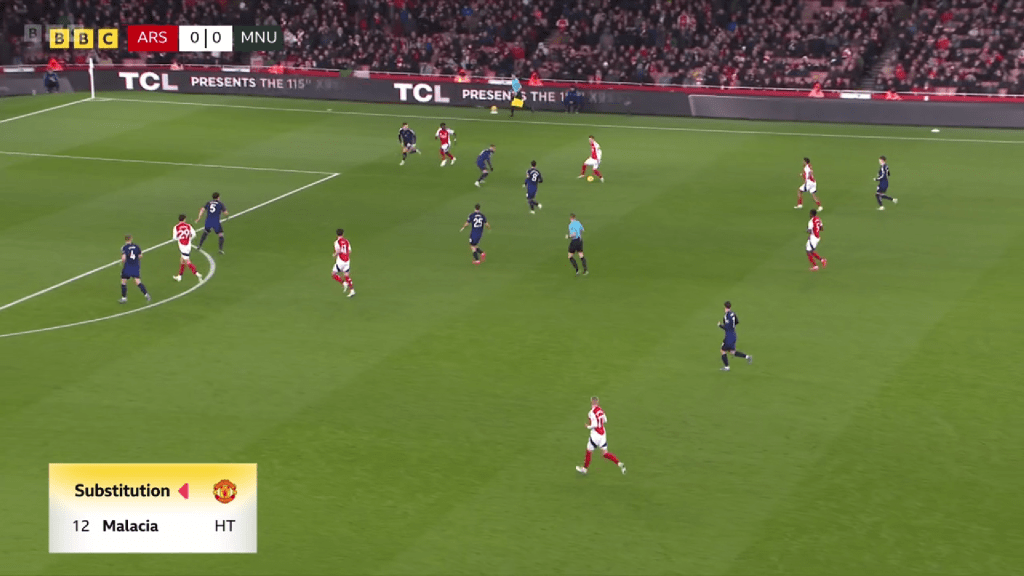
Arsenal’s unrelenting quality from set pieces has been discussed at length in recent weeks, but in lieu of their disappointing Premier League draw to Fulham and the fact that 6 of their last 8 league goals have come from set pieces (4 corners, 2 penalties), questions can be asked of Arsenal’s inability to score from open play.
But casting our minds back to the previous two seasons, Arsenal had become synonymous with free-flowing football and positive chance creation. So what’s changed?
Defensive Shift
Over the past season or so, Mikel Arteta can be seen to have taken on board the famous words of Sir Alex Ferguson: “attack wins you games, defence wins you titles”.
Last season Arsenal conceded their Premier League record lowest number of goals at 29 – 14 fewer than the 43 of 2022/23.
Yet the Gunners also managed to score the most goals they ever have in a Premier League season at 91 – 22 of these coming from set pieces.
The process of becoming more defensively minded can be offset by an uptick in set piece goals scored, but Arteta’s Arsenal lag significantly behind their league rivals in terms of expected goals from open play in the Premier League this season.
| xG (Open Play) Per 90 | xG (Set Pieces) Per 90 | |
| Arsenal | 1.06 | 0.58 |
| Chelsea | 1.77 | 0.24 |
| Liverpool | 1.6 | 0.26 |
| Manchester City | 1.49 | 0.4 |
But what is it specifically that Arteta has changed to become more defensively sound – and why has it affected their attacking threat from open play so much?
Support For Saka
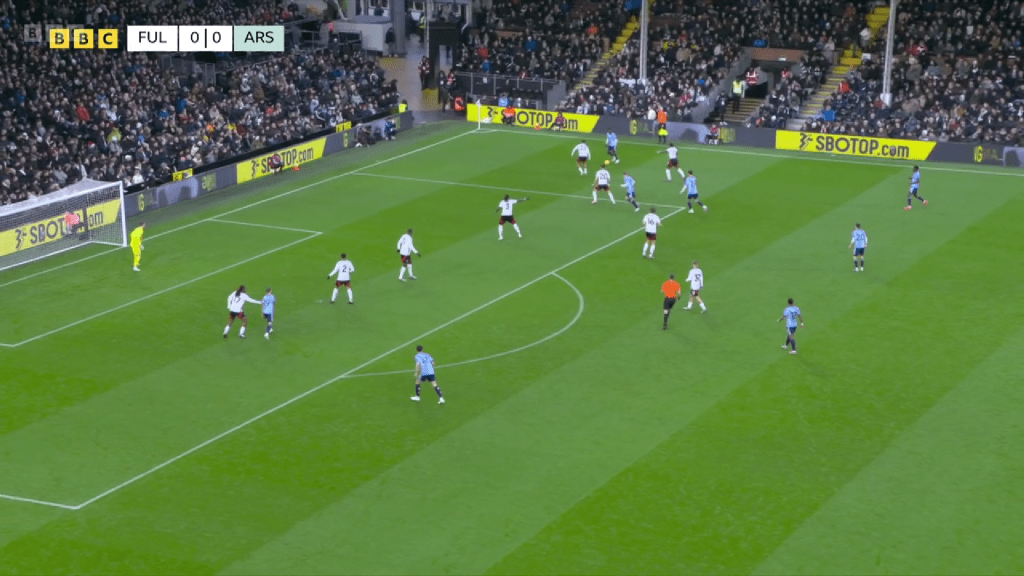
Fulham’s Antonee Robinson and Sasa Lukic did a remarkable job mitigating Arsenal’s main threats Bukayo Saka and Martin Odegaard in yesterday’s game, but there was a selection choice from Arteta that gave the Cottagers an advantage from kick off.
The selection of Thomas Partey at right back, although providing additional cover and an extra body in midfield to prevent counterattacks, resulted in Saka often receiving the ball in a 1 vs 2 situation – and, brilliant as Saka is, he struggled beating 2 men consistently, thus held less threat to the Fulham goal.
Lukic being glued to Odegaard whenever Arsenal were in possession also meant that Saka often had no ‘out ball’, and attacks often ended in low quality chances.
It can be suggested that Arteta’s hand has been forced into this change with Ben White’s recent surgery and Riccardo Calafiori sustaining another injury, but the root of the issue is possibly not that simple.
Ben White’s relentless overlapping runs which often led to Saka finding additional space or having an extra forward option have recently become a thing of the past; when the Englishman has played this season he has made noticeably fewer forward runs than in the last few years, with Arteta preferring him to remain central and slightly deeper.
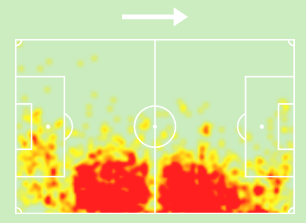
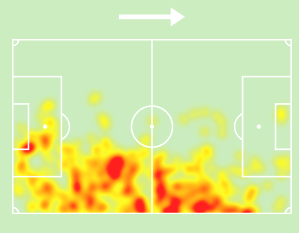
Arsenal fans may remember that Arteta tried a similar experiment at the start of last season – where Partey started at right back and inverted into midfield for the first three league games. They failed to create any big chances in their victory over Nottingham Forest, won 1-0 with a penalty against Crystal Palace, and failed to see out a 2-1 lead against 10-man Fulham in these opening three games.
In short, despite accumulating 7 out of 9 points, the experiment was a failure. White swiftly returned at right back and Arsenal returned to more free flowing football.
Arteta hasn’t acknowledged that Arsenal’s chance creation is a worry: claiming that “we can generate other stuff”, but the Spaniard will be scratching his head over how his team can provide more open play threat without compromising themselves defensively.
Their generous December fixture run could still be a great time to develop an attacking rhythm.
Forward Thinking
Throughout the summer transfer window, Arsenal fans were calling out for their team’s need for a striker. Kai Havertz, despite 20 goal contributions throughout the 2023/24 Premier League season, can still be seen to lack the ‘striker’s instinct’, a bone pundits often pick with the German.
What a ‘striker’s instinct’ actually means is quite foggy – Havertz has frequently chipped in with a traditional poacher’s goal or with a run off the last defender, but his output has been hurt by the aforementioned changes Arteta has made this season.
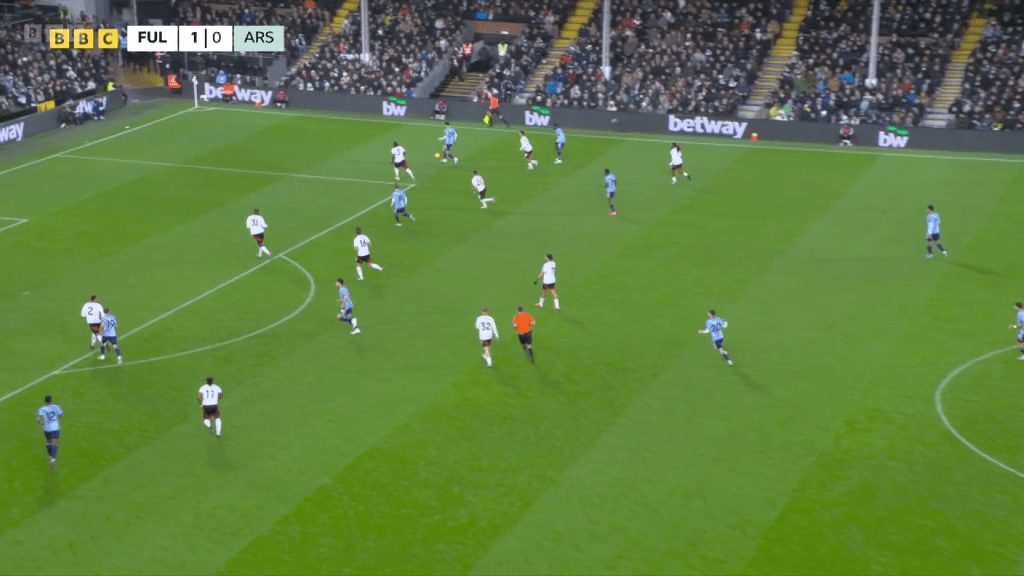
As seen above and frequently throughout this season, Havertz has supported Saka down Arsenal’s right, vacating his space in the box for Declan Rice or a left winger to run into.
This can be seen as a run designed to confuse defenders over who they should be marking, but it has seen limited success this season. The more common outcome is that Havertz plays the ball to Saka and leaves himself in a position where he is unable to affect the game.
As a result, Arsenal essentially end up attacking a man down.
Are Trossard And Martinelli Good Enough?
Gabriel Martinelli will always be seen as one of Arsenal’s biggest success stories. He was found in the lower leagues of Brazilian football, and has become a well established Premier League winger. However, his recent form and lack of output has called into question the ceiling of the 23-year-old, and whether he is ‘the man’ for Arsenal’s left wing to go and win them a title.
Leandro Trossard can equally be considered a question mark. He has become synonymous with goals from the bench, but frequently under-delivers when starting games.
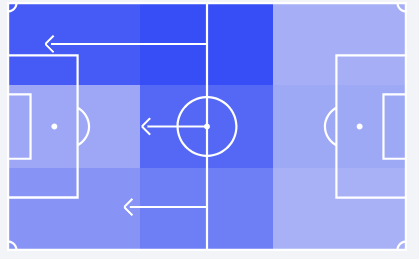
The result has been that Bukayo Saka has been directly involved in 15 of Arsenal’s 29 league goals this season (including set pieces). Martinelli and Trossard have been directly involved in 9.
Saka’s brilliance means he is always likely to outperform Arsenal’s left, but it’s days such as yesterday where he is marked out of the game where other attacking players need to stand up and perform if Arsenal are to win a title.
A simple comparison can be Liverpool’s wingers of a few years ago: Sadio Mane and Mohammed Salah were almost always neck and neck for goal contributions, and at least one of them would normally pop up with a goal at a vital time. At this moment in time, Arsenal simply don’t have that.
Arsenal’s lack of ‘star quality’ outside of Saka and Odegaard is worrying for their title hopes, and outside of a change of form or personnel down their left, it is hard to see where the extra attacking threat could come from.
 Pressing Issues
Leave a comment