
Manchester City players and fans were surprised on Tuesday night when they were awarded a penalty over the ball striking Sporting centre-back Ousmane Diomande on the arm, from little more than a yard away, and before Diomande knew anything about it. So surprised, perhaps, that after a lengthy VAR check, Erling Haaland rattled the crossbar from the spot, and failed to get City back into the game.
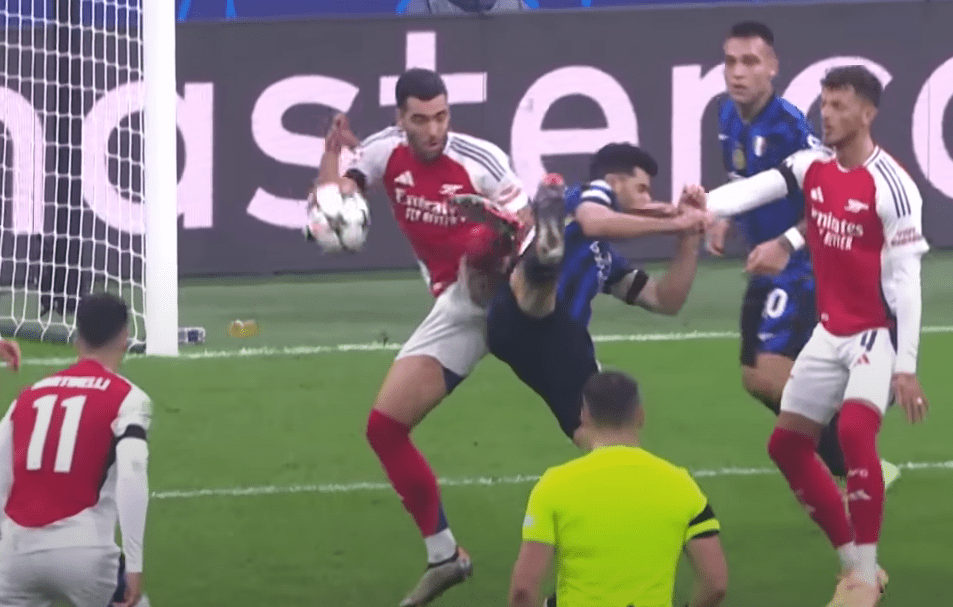
The same ruling would impact Arsenal the next night, when summer-signing Mikel Merino was hit on the arm by the ball in a similar fashion at the end of the first half. Inter’s Hakan Calhanoglou would go on to score the penalty, which was enough to decide the game.
Neither incident would have been given as a penalty in the Premier League, which has raised a question over how the two competitions can have different rules over the same sport. The different laws have caused confusion and frustration amongst fans. It also turns out that the handball laws are not the only discrepancy between the two competitions.
Different Officiating: is it a problem?
There are two notable differences between how the England’s top division and the Champions League operate in terms of ruling – the involvement of VAR with offside decisions and the handball laws.
Both of these can have frustrating impacts. UEFA’s ‘semi automated’ way of determining close offsides is quick, reliable and effective. Conversely, Premier League fans frequently endure a lengthy process of line drawing, which has at times led to questionable or completely unfathomable decisions. While this is an inconvenience, it doesn’t particularly impact players.
The difference in handball laws has more of a direct impact on players – and can be confusing for fans.
The FA’s Premier League rules for 2024/25 include ‘mitigating factors’ over whether a handball will be a awarded or not. These factors include ‘proximity to the ball’, ‘if the player is using their arm to support their body’ and ‘if the player deflects or plays the ball into their own arm. UEFA’s ruling doesn’t consider the player’s proximity to the ball (which is what hurt Merino and Diomande this week) – their ruling is that handball should be awarded ‘unless the defender’s arm is very close to or touching the body’.
Essentially, the discrepancy in wording dictated two decisions this week (I don’t think Aston Villa’s Tyrone Mings has a strong argument). TNT Sports’ Ally McCoist stipulated that “the laws need to change” during commentary.
There is a case for this, but it is unlikely to occur anytime soon. The Premier League and Champions are governed by completely different organisations, which would make implementing any changes very tricky.
As a result, players will likely have to get used to the slightly different rules in the two competitions.
 Pressing Issues
Leave a comment